About 45 miles south of Cocodrie, LA, Jen Carroll dropped a live bait through about 300 feet of cobalt-clear water. The terminal end began jittery twitching. Moments later, the broomstick-stout big-game rod bent into a U as if hooked into a submarine.
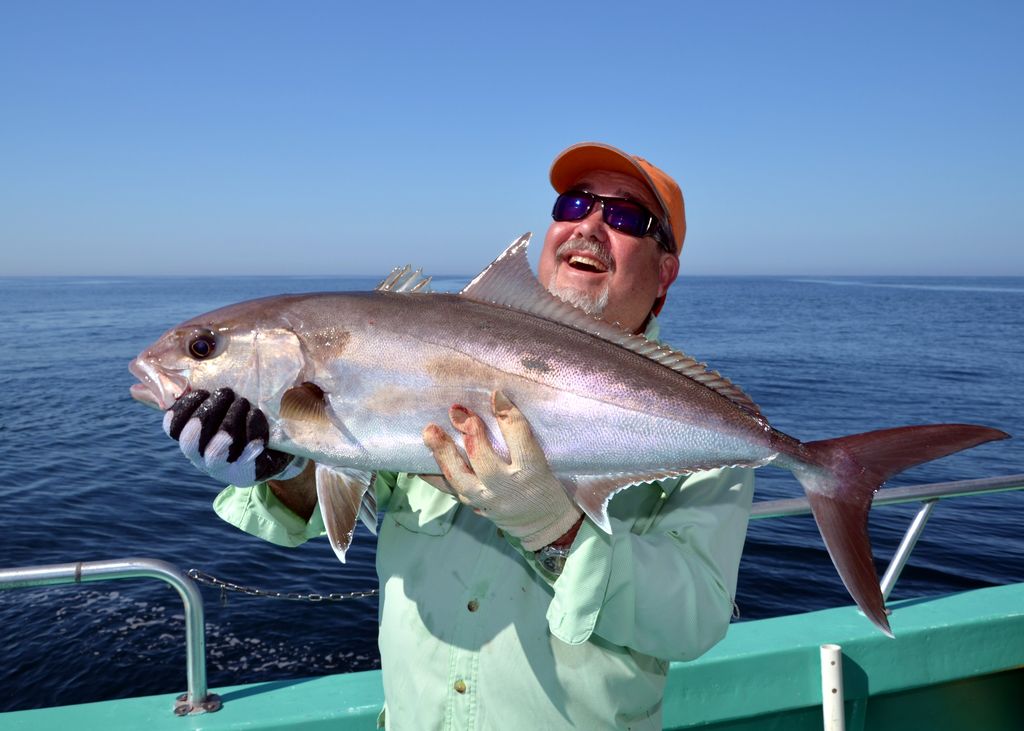
“It’s like pulling an anvil off the bottom!” she exclaimed. “It’s just weight and power. I’ve caught big fish before, but nothing that fought like this. It’s not moving. I’m getting my workout for the week in just minutes – and what a workout!”
Only brute force could subdue raw power as Jen battled her first Amberjack, perhaps the strongest fish, pound for pound, in the Gulf of Mexico. Eventually, the exhausted young woman landed the beast.
“Harder to Pry off a Reef than a Donkey off a Mountain”
“Fighting a big Greater Amberjack is like getting on the roof of a house with a broomstick, a short length of 1/4-inch rope and a refrigerator,” quipped Tommy Pellegrin of Custom Charters in Cocodrie. “Tie the rope to the end of the broomstick and the refrigerator. Hold onto the broomstick and kick the refrigerator off the roof. Anyone who can stop that refrigerator from hitting the ground can fight an Amberjack!”
Greater Amberjack range throughout the world’s tropical and temperate seas. In the Atlantic Basin, they occur from Nova Scotia to Brazil and throughout the Gulf of Mexico and Caribbean Sea. Often called “reef donkeys” for their sheer strength, stubbornness, and pugnacity, Amberjack can top 160 pounds and might stretch more than five feet long.
“Amberjack are harder to pry off a reef than a donkey off a mountain!” exclaimed Ben Allen with Biloxi Blue Water Charters in Biloxi, MS “They’re hard fighters and good to eat. Amberjack fishing off the Mississippi Coast is pretty good with many fish ranging from 40 pounds up to more than 100 pounds.”
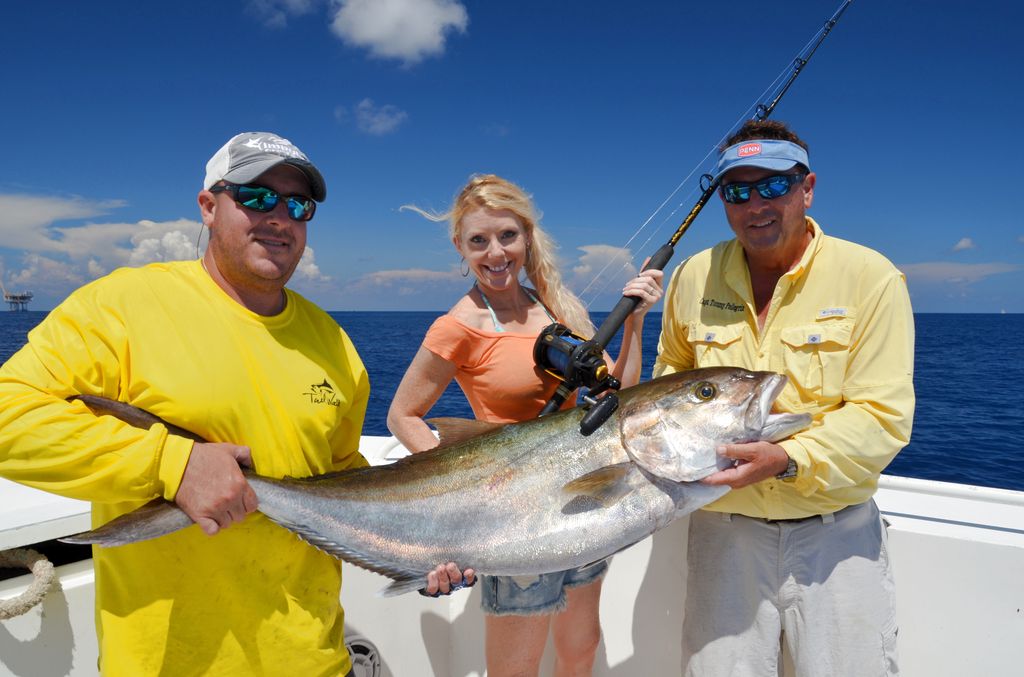
Lacking blazing speed like King Mackerel or Yellowfin Tuna, Amberjack simply hunker down in structure and dare anyone to pull them up from the depths. Unless a giant Grouper or Shark shows up, large Amberjack dominate deep rock piles, reefs, wrecks and other hard structure. When hooked, these incredibly strong fish try to burrow into entangling cover and won’t budge.
“To catch monster Amberjack, use a reel with a welded drag that won’t give,” Pellegrin said. “Attach that to an unlimited class rod. Put it in a good rod holder. Pull the fish away from the structure with the boat motor.”
Greater Amberjack challenge even the toughest angler and tackle. Fishing for them requires considerable backbone – in both equipment and the person holding it! When hooked, Amberjack quickly race to the most gnarly, sharp, barnacle-encrusted structure to rub lines against these objects to break them.
“The biggest mistake people make when trying to catch Amberjack is underestimating their power!” Pellegrin advised. “Divers tell me they’ve seen Amberjack in the 120- to 130-pound range with several hooks hanging out of their mouths.”
Where to Find Reef Donkeys
To find Amberjack, first find the deep structure. Usually, the pugnacious powerhouses like to stay in water at least 150 feet deep out to more than 600 feet deep. They might appear in water as shallow as 80 feet, but for their optimum depth range, look for water 200 to 300 feet deep.
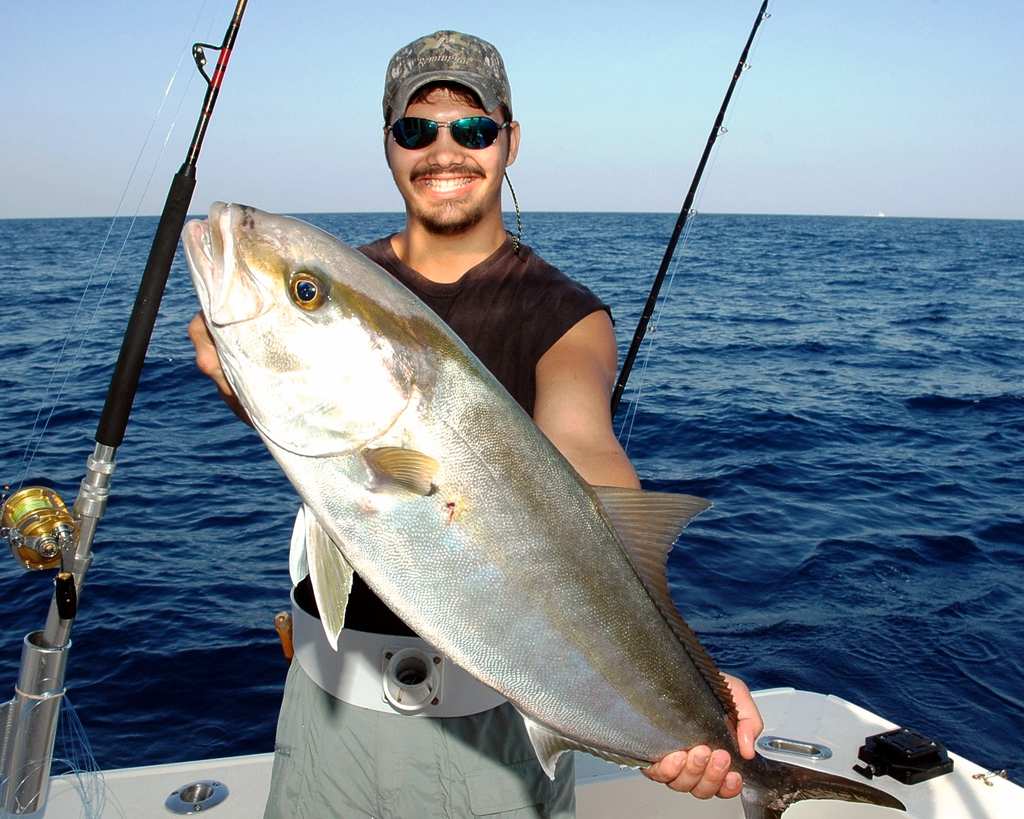
Fortunately, Gulf anglers don’t need to search very hard to find abundant reefs in deep water. Alabama and Mississippi both established numerous artificial reefs ranging in size from a few concrete blocks to entire ships.
Off Pensacola, FL, people can even fish over an entire aircraft carrier. The U.S.S. Oriskany, a veteran of both the Korean and Vietnam Wars, sits in more than 200 feet of water. Panhandle anglers running out of Destin, Panama City, and Steinhatchee troll or bottom fish for varied species including Grouper and Amberjack. On any given day, anglers could pull 10 to 12 different species from the same spot.
“Grouper is our bread-and-butter fish, but we also catch Amberjack on some of the offshore wrecks and bigger structures,” stated Brian Smith with Big Bend Charters who runs out of Steinhatchee, FL “Deep-sea fishing is great year-round in Steinhatchee. We might also catch Red Snapper, Cobia, and King Mackerel.”
Oil Platforms and Natural Reefs
Off Louisiana and Texas, thousands of petroleum industry structures ranging from a few pipes sticking out of the water to massive floating platforms dot the horizon. The oldest platforms make excellent fishing reefs. Years of growth builds up on any hard objects in water for long periods. Sometimes, the biggest fish cruise 40 to 50 yards away from the structures, especially heavily pressured reefs.
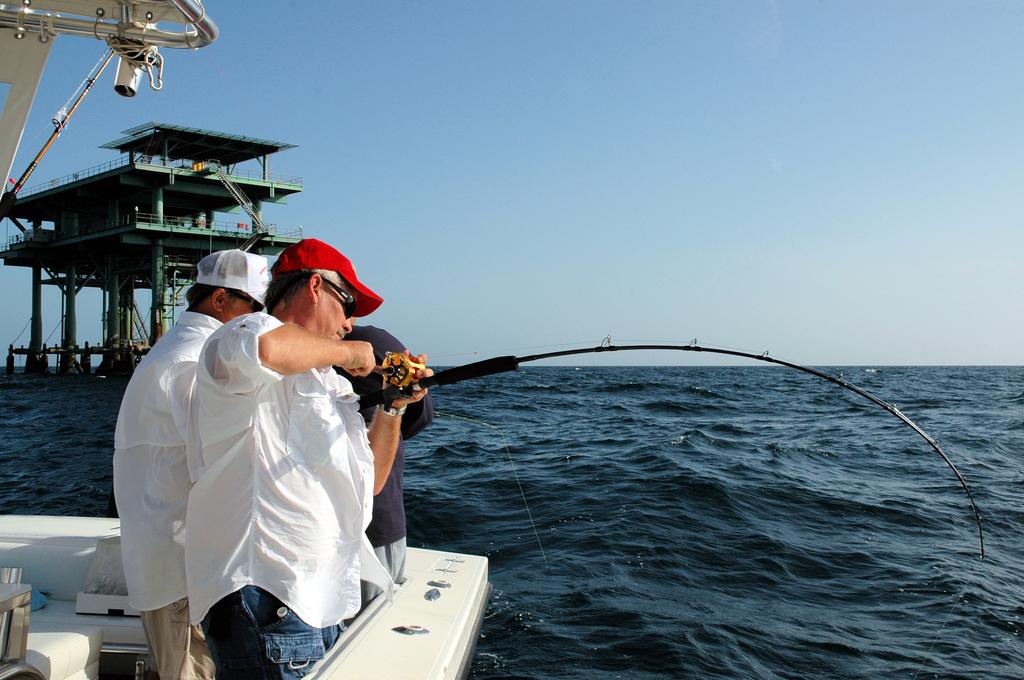
In the Rigs to Reefs program, companies cut off old decommissioned platforms deep enough for safe boat traffic, but the bottoms remain in place as artificial reefs. Even where companies completely remove structures, old shell pads, junk that fell off the platforms, and other objects remain on the bottom and could provide places for reef fish to hunt.
While many people fish the numerous petroleum industry platforms in the Gulf, anyone can see them miles away. However, many smaller natural reefs hold Amberjack and other fish. These structures don’t attract as much attention. Anglers should look for small reefs, rock piles, and wrecks that receive considerably less pressure and hold good fish.
“I prefer to fish natural structure,” revealed Chad Kinney of Bamm Bamm Charters from Port Mansfield, Texas. “We catch bigger fish around deep reefs because they don’t usually have as much entangling structure to break lines. We usually start finding Amberjack in 150 feet of water about 30 miles from Port Mansfield. The best luck I’ve had was in about 300 to 350 feet of water about 50 miles out. Another good spot is about 45 miles out in about 270 to 380 feet, depending upon the depth of the wrecks and reefs we fish.”
Finding Amberjack Spots
Use electronics to search for structure and locate fish. Sometimes, Jacks stay on one side of a structure or the other, depending upon current flow and other factors. In strong current, fish habitually hold on the upstream side. They face into the flow. With quality electronics, anglers should be able to locate the fish and the depth where they want to stay.
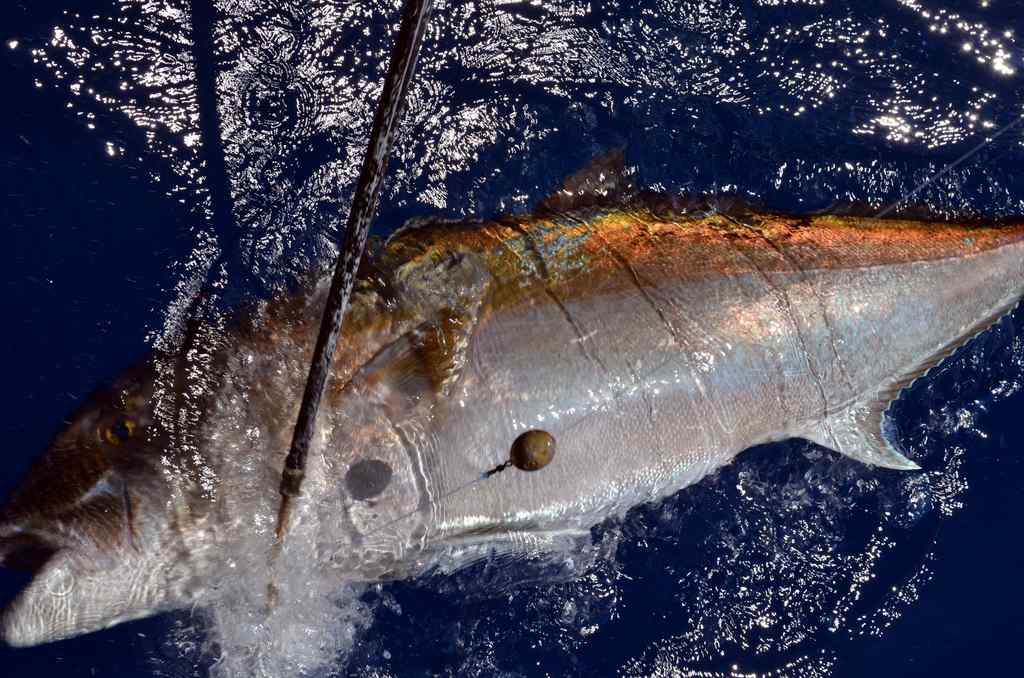
“A good electronics unit is a must to find Amberjack, especially the bigger fish,” Pellegrin explained. “Keep an eye on what’s going on beneath the boat. We must see fish on the finder before we send any lines down or we’re just wasting bait.”
Around these gnarly structures, the reef warlords wait to ambush any unsuspecting creatures that venture too close. The voracious predators eat almost anything they can grab and swallow, including mollusks, crustaceans, and other fish.
“Amberjack eat a wide variety of prey including crabs, squid, and fish,” advised John Mareska, an Alabama Marine Resources Division marine biologist on Dauphin Island. “Once they find a reef structure or a complex of reefs, they usually stay in that area. Amberjack are not migratory fish, but they move up and down throughout the water column. They even come up very close to the surface occasionally, but they typically try to associate with some particular type of structure.”
The Best Bait for Amberjack
For massive Amberjack, most anglers use live bait such as small jacks, croaker, mullet, menhaden, or other fish. Hardtail jacks, also called blue runners, about eight to 12 inches long make excellent baits. Ruby lips, small grunts with orange-red mouths also known as tomtate, grow to about eight inches long and make great Amberjack baits. Squirrelfish, hornbellies, also called atlantic bumper, and other fish also make great Amberjack baits.
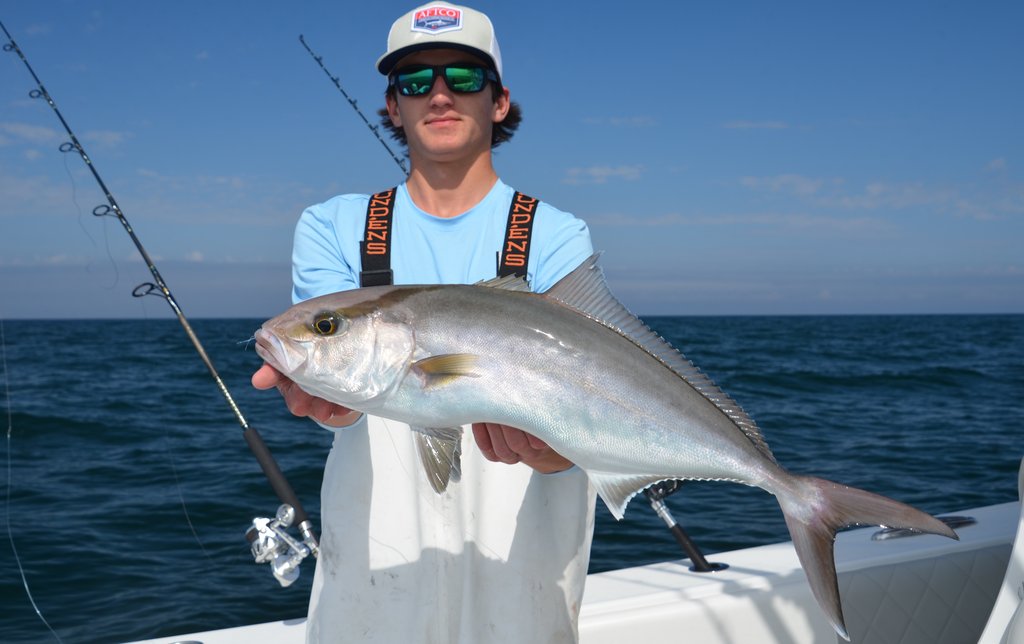
“Hardtails are really good bait fish for Amberjack,” opined Bobby Walker of Summer Breeze Charters who runs out of Orange Beach, AL “Ruby lips are another good bait. A huge Amberjack can eat a big fish. I’ve seen Amberjack with mouths big enough that they looked like they could swallow a basketball!”
A bruiser Amberjack can easily gulp down a substantial bait. AJs might also eat fresh dead baits, cut baits, squid, and fish strips undulating in the current, but usually prefer live fish. Numerous nibblers, such as small Snapper and Triggerfish, quickly consume smaller baits before large Amberjack even see them. Many people first catch their own bait fish by throwing sabiki rigs, a cluster of tiny flies, on light tackle.
“For Amberjack, I like to use live 4- to 5-pound hardtails,” commented James McCanless of Aquiline Custom Charters in Biloxi, MS “Amberjack bite faster with bigger baits. A big Amberjack will inhale a bait that size and smaller ones won’t mess with it. We’ll stop around a shallower platform in 70 to 80 feet of water and throw Got-cha Plugs or sabiki rigs to catch Hardtails for live bait.”
Amberjack Fishing Rigs
Rig live baits with 8/0 to 13/0 circle hooks on a Carolina rig so the fish can swim more easily. The more active it stays, the more likely it will attract attention. Use just enough weight to get the bait to the bottom or the desired depth. Clip the tail fin so the fish struggles to swim, sending vibrations radiating through the water. Anglers can hook bait fish many ways, but threading the hook through the jaw sends it down head first so it can swim more naturally.
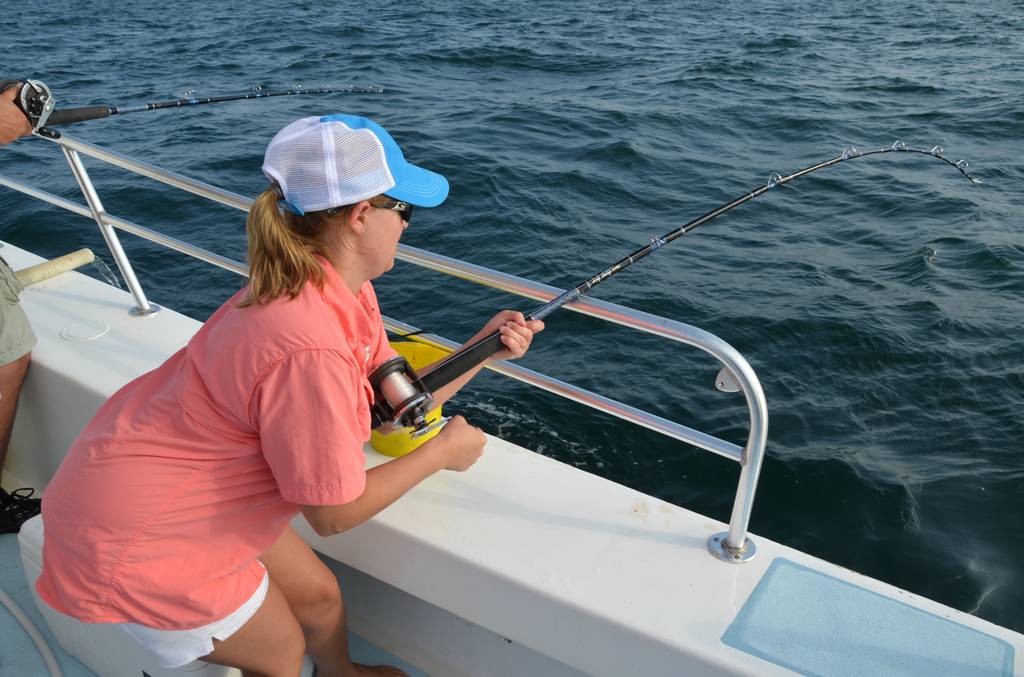
“We use a Carolina rig, depending on how deep we’re fishing and how the current is running,” explained Alex E. McIngvale with Shore Thing Fishing Charters in Pass Christian, MS “We’ll use an 8- to 16-ounce weight on a 3- to 5-foot length of 80- to 200-pound test leader, depending on the type of structure. For Amberjack, we don’t need to use fluorocarbon leaders. When they’re feeding, they are not that picky. We’ll attach a 10/0 to a 20/0 circle hook to the leader.”
Although Amberjack like deep structure, the biggest ones don’t always stay right on the bottom. Sometimes, they roam at varied depths. Use electronics to locate where fish want to stay. To reach that depth, lower a bait slowly at controlled intervals to determine the right depth.
“Usually, Amberjack suspend up off the bottom,” McIngvale remarked. “They frequently hover above the main part of the structure. They might be from right below the surface to three-quarters of the way down in the water column. We try to see the depth where we’re marking the fish on the sonar. When they suspend, they are easy to distinguish from Snapper or other fish and bottom structure.”
A drift line sweetened with live bait can be highly effective for attracting suspended fish. Even when bottom fishing, many anglers put out a drift line or two sweetened with live bait fish. Besides Amberjack, a drift line might also interest Grouper, big Red Snapper, Cobia, Mackerel, or Wahoo – perhaps even Tuna or Sailfish, depending upon the location.
First, cut up bait fish or squid into tiny pieces and toss them in the water for chum. This could bring large fish toward the surface. Use pieces only big enough to keep fish interested, but not enough to feed them. Rig a free line with no weight so the bait fish can swim freely. Toss it into the chum slick. Set the rod into a holder and engage the reel clicker.
Amberjack Fishing Lures
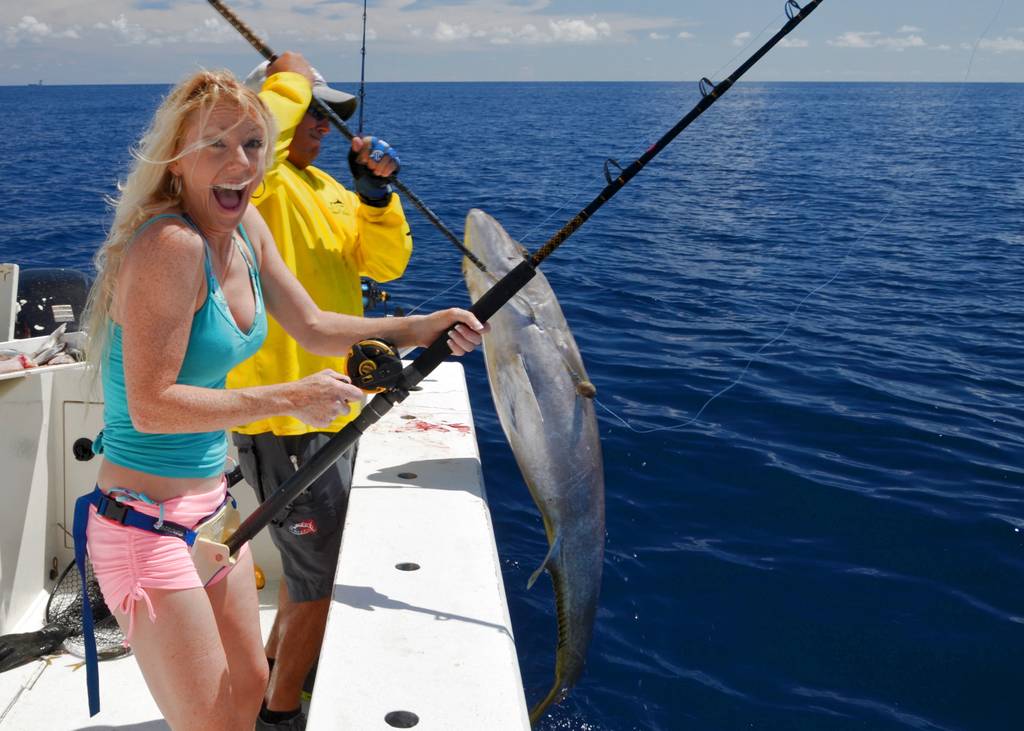
Anglers traditionally catch more Amberjack with live baits, but the powerful fish sometimes hit artificials. Fly rod enthusiasts occasionally cast for them in chum slicks. Some anglers troll live baits, diving plugs, or plastic squid baits near reefs. Run baits parallel to the reef edges or rig baits to run just over the reef tops. Circle reefs or platforms several times and use various lures in diverse colors that dive to different depths to determine the best patterns for that day.
“When we mark Amberjack higher in the water column in shallower water, we’ve had really good luck catching them on bucktail jigs, something like a larger, heavier Cobia jig,” McIngvale described. “We also catch them on lipped trolling baits when fishing for Wahoo in the winter. Most of the lipped trolling baits run about 30 to 50 feet deep. When they come up close to the surface, we sometimes catch Amberjack on fly tackle. We normally use 300- to 600-gram sinking line and a large streamer-type fly.”
When big Jacks hover, try dropping heavy jigs to them. Mark the depth where the fish want to stay. Heavy metal jigs mimic dying bait fish as they flutter down. Send the jig deeper than where the fish hover. Yank it back up through the fish, but not all the way to the surface if nothing hits. Keep sending the lure down and jigging it up through the fish.
“When vertically jigging for Amberjack, I like to use a Penn 6500 spinning reel spooled with 65-pound test braid,” Kinney said. “I rip it through the water column really fast. For big Amberjack, we don’t want to slowly vertically jig it like for a Grouper. We don’t use bait with it. They will attack it. If we’re fishing in 150 feet of water, they might be 60 to 70 feet deep. If we’re fishing in 300 feet of water, they might be 150 feet deep.”
Different states as well as the federal government each set different seasons, limits, and regulations for Amberjack. Rules can change – always check with NOAA Fisheries or your relevant state agency before heading out.
All photos in this article are courtesy of John N. Felsher.
The post Reef Donkeys: Expert Tips for Catching Amberjack in the Gulf of America appeared first on FishingBooker Blog.
https://ift.tt/WD5zr8l
0 Comments
Enregistrer un commentaire